Showing posts with label Azerbaijan. Show all posts

Wednesday, January 4, 2012

Bad Neighbours make Good Fences: How to Navigate the Caucasus on a Motorbike


The most tense border crossing I've ever made was with Giulia - returning from Mexico to the US through Nuevo Laredo in March last year. Although the leadup was uneventful, the tension increased steadily the nearer we got to the border, finally reaching fever pitch as our 1976 Chevrolet Sportsvan was inspected by the US customs station. Aside from the usual fear of authority drilled into anyone who went to a Christian Brothers school, at the core of the anxiety was the question what the hell happens once you have left Mexico but then get denied access to the US? We were essentially in no-man's-land having already given up our vehicle permit and visas before crossing the bridge that towers over the dribbling Rio Grande. My assumption was that the only available option would be to reapply for both, perhaps dealing the deathblow to our already wretched finances and somehow head back the way we came. I was curious but I didn't want to ask the custom's guard, bloated not just with tex-mex cuisine but his own sense of self-importance questions which would most likely be responded to by "why do you want to know what happens if you don't get let in?"

I got a jolt of cold lightning up my spine when they asked me for a document that I did not have. This was followed by soft relief when I was told that I could buy another one. While I filled out the necessary forms the latex gloved customs guards went through our van. I spied out of the corner of my eye a sign which had "You MUST declare" then a list of things which included mangoes. We had mangoes in the back which I hurriedly declared to one guard. He came right up to me and said "You're lucky you did that - we could have sent you back". Eventually, without smile or character, they told us we could go having left our van a violated mess (unlike the Mexican guards that always left everything immaculately). I drove off into the Texas afternoon completely relieved. Incidentally, my plan, if I got turned back from the US was drive 1100km back to Mexico City - sell the van and fly back to Australia from there. I would have missed out on my existing flight and a meeting with someone that had already agreed to buy the van.

Border crossing are almost always tense but you can usually consider them in isolation, on a case-by-case basis. By contrast the South Caucasus is a complex web of ethnic tensions, closed borders and Soviet style bureaucracy. This means that a comprehensive tour of the region must be planned in advance and take into account each restriction which could impair your movement, understanding that entry here might cause problems there. It is also important to take into consideration the mode of transport you intend to take – some states will place further restrictions or import taxes on you if you want to bring your own car or motorcycle.
Understand that this region is still in a state of flux - with the most recent major changes to the map happening as recently as August 2008 with the borders of South Ossetia and Abkhazia being redrawn as a consequence of Georgian-Ossetian conflict. The main reason why the South Caucasus has not organically reached a level of stability is that the freeze imposed on the region when it was part of the USSR, has now gone. The tensions that predated the Bolshevik revolution have reignited and begun to smoulder again, occasionally combusting. As a result it is always necessary to seek the latest information before you travel there – any one of the countries or autonomous states described below has the potential to change at any time for a reason as seemingly insignificant as if one country is hosting the Eurovision finals.

FENCE 1 – Azerbaijani-Armenian border is closed

Nagorno-Karabakh - the name alone is a cultural hodgepodge (Nagorno is Russian for "highland" while Karabakh is Persian for "black garden). The image (right) of flaming hole in the heart of Azerbaijan has been taken from the Azeri Ministry of Foreign Affairs website. This flaming hole (the flames are animated on the website) represents Nagorno-Karabakh which is an enclave, with an ethnic Armenian majority, entirely surrounded by Azerbaijan. Conflict in Nagorno-Karabakh has its roots in 1921 when, after centuries of Armenians and Azeri's living side by side, the early Bolsheviks established it as an autonomous Armenian state within Azeri territory. This was a move by the Bolsheviks who attempted to maintain control by exploiting regional tensions. It is said that Nagorno-Karabakh caused the end of the USSR - being the first to reclaim power to its local Soviet from the Supreme Soviet in Moscow, it was the thread that unravelled the whole red sweater breaking a Soviet taboo thereby undermining the legitimacy of the entire regime. Without Soviet control Azerbaijan attempted to claim Nagorno-Karabakh as its own. Armenia responded with the idea of protecting the Armenian ethnic majority there. This resulted in a series of escalating conflicts began and lasted from 1988-1994 with heavy civilian casualties on each side. A ceasefire declared in 1994 was by no means an end to the violence with sporadic skirmishes still erupting on both sides, the latest of which was in March 8 2011.
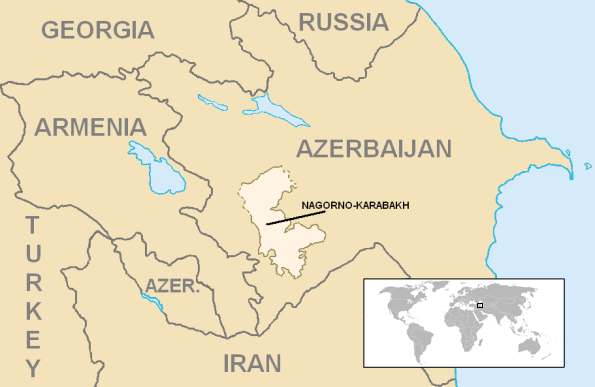
Domestic opinion in Azerbaijan and Armenia of the Nagorno-Karabakh issue is uncompromising toward the other - both see this as a sacred issue over which they are not willing to budge. The animated image on Foreign Affairs website perfectly describes how sensitive the Nagorno Karabakh issue is in Azerbaijan. Although Nagorno Karabakh is autonomous it seems to move in step with Armenia with the Karabakh party holding a great deal of sway in the capital. The situation has not improved because there is no dialogue between the two states which is a function of the less than pluralistic regimes in these countries (in 2000 peace plans were conducted by the respective leaders without opening up the issue for debate within their societies). Thus if we view the closed borders as closed not just physically but also in terms of flow of opinion between the Azerbaijan and Armenia we get an understanding why so little of the explosive potential of the issue has dissipated since 1994.

The Nagorno-Karabakh issue impacts on travellers in two ways: the first and most obvious is that the border between Azerbaijan and Armenia is closed. The second is only relevant if you wish to travel to Nagorno-Karabakh itself. At the time of writing the Australian Department of Foreign Affairs site Smart Traveller has the region under a “Do not travel” status. I have heard that the enclave is most likely safe provided you stay away from the Azerbaijan border but do not take this as gospel. Nagorno-Karabakh is accessible from Armenia via the Lachin corridor, a mountain pass legally in Azeri territory but effectively under Armenian control. A visa is available in Yerevan the Armenian capital. Note that any evidence of this in your passport means you would be refused entry into Azerbaijan. I've heard that even having an Armenian sounding name can cause problems when crossing into Azerbaijan. Ask for the visa to Nagorno-Karabakh on a separate piece of paper which can be discarded before entering Azerbaijan.
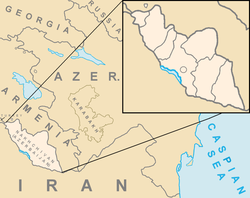
Also relevant to this border being closed is Nakhchivan the Azerbaijani landlocked autonomous enclave which shares a border with Armenia on the western side. Nakhchivan is geographically isolated from the rest of Azerbaijan, and the Caucasus because it's only borders are with Armenia which is closed, Turkey and Iran. This means that the state can only be accessed via either Turkey and Iran.

FENCE 2 – The Georgian-Russian borders are Closed

The two states, grouped into a single conflict could not really be more different from one another. First is South Ossetia a mountainous grassland which pokes below the Caucasus mountain range. It's population is poor, mostly Ossetians with a minority of Georgians. South Ossetia separation from Georgia is a legacy from the Soviet Union, when the Ossetians sided with the invading Russian Bolsheviks against the Georgian Mensheviks. The second state is Abkhazia which contains the subtropical sea resorts favoured by Soviet Party leaders, including Stalin, and the Ottoman Turks before them. Because of this appeal Abkhazia has a history of being a cosmopolitan destination home to Greeks, Jews and Armenians as well as it's native Abkhaz population which is slowly regaining a majority after being deported en masse during the Soviet era as enemies of the Soviet Union. 
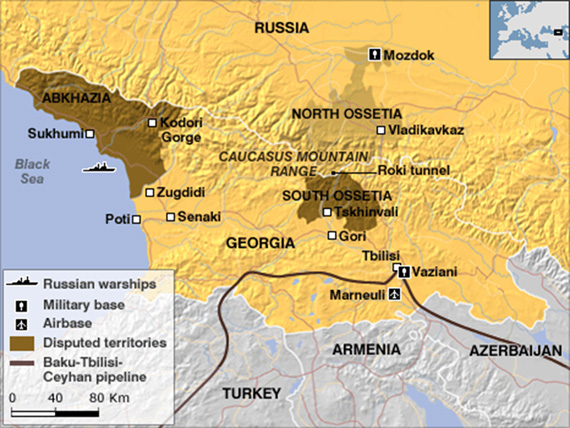

Observe the way that both these states dip below the natural border of the Caucasus mountain range, the highest mountain range in Europe. It is clear that they are implied targets in the "restoration of Geogria's territorial integrity" which Georgia's president, Mikheil Saakashvili, promised to fulfil in his first term. Russia saw Georgia's new Western orientation as a threat, to which it responded by offering protection to South Ossetia and Abkhazia against Georgia. The resulting South-Ossetian war was depicted in the West as the result of Russian aggression but Georgian nationalism and the belief in Georgia that the west would lend more support than it did lead to the impasse.

One of the most bizzare moments that demonstrates how divisive an issue South Ossetia is is in the lead up to war, Saakashvili invited 70s band Boney M (Ra Ra Rasputin) to the Georgian inhabited town in the heart of South Ossetia. There were claims by Boney M that the band that played there that day were actually imposters.

Georgia lost badly in the 2008 war, losing territory as well as having most ethnic Georgian's expelled from Abkhazia and South Ossetia. The borders from Georgia to Russia as well as these two states are now closed, so they are only accessible from Russia. These borders are patrolled by Russian peacekeepers - one of which said in one interview they were waiting to tear off their peacekeeping armbands and go back to war. Furthermore both Abkhazia and South Ossetia, just as with Nagorno-Karabakh, are not recognised as real states by the rest of the world so are forced to rely increasingly on Russia.

In terms of travel plans, without a very large detour through a third country (Azerbaijan-Russian border is closed to most passports) it is a matter of either visiting these two states and Russia or visiting the rest of the Caucasus. Even travelling by boat to/from Abkhazia is not an option as Georgia has a naval blockade of Abkhazia. The best option is if you are travelling into the Caucasus, black out the areas on your map and, travel wise, just pretend they don't exist.

FENCE 3 – The Armenian-Turkish border is closed


With Armenia on the fringes of Christian world it was always going to be exposed when the radically pro-Turkic Young Turks came to power in 1908. Sandwiched between the Ottoman Empire and the Russia Empire, Amenia allied itself with Russia when Turkey lauched an attack on the Caucasus. Turkey suffered one of the largest defeats in military history and responded with the forced deportation of nearly a million Armenians from Anatolia in Turkey. Most died en route to deserts in Syria or Iraq. This is known as the Armenian Genocide.

The current rift between Armenia and Turkey is not due to the event itself but is largely because of Turkey's failure to recognize it as an act of genocide, terming it instead as a consequence of war. A good deal of the evidence points to event as a deliberate attempt to clear East Anatolia of it's Armenian inhabitants. Although there is still a strain of ultranationlism in Turkey that continues to deny the act was genocide this fence is the most likely to come down soon with the Armenian president attending a football game between Turkey and Armenia, congratulating the Turkish president when Turkey scored.

This border being closed does not have a massive impact on a trip through the Caucasus on it's own but when combined with the fact that Armenia also has closed borders with Azerbaijan and Iran requiring a visa to enter, it does potentially make Armenia a little bit of a cul-de-sac. Travel to Turkey is easily achieved using Georgia as a transit country.

FENCE 4 - Limit of 72 hours on a Motorbike in Azerbaijan


While more of a conceptual barrier that a geopolitical fence - this little Azerbaijani policy has the potential throw your entire trip in to disarray. I have had trouble finding where the policy is directly referred to in official government documents but it has been mentioned on numerous forums by people that have experienced it first hand. As far as I can surmise the policy is that it is possible to bring in a car or motorbike for a maximum of 72 hours (to the minute) on a temporary importation document. The consequences of overstaying this is a massive fine for each day spent in excess of this time.

This issue has caused more agony than any others during planning, and might make you try to resort to taking public transport. Considering that at its narrowest point from Georgia to Baku the distance is 333km this might not be a massive problem until you consider exactly where Azerbaijan is situated - which is on the edge of the Caspian, with its border to Russia closed to all but CIS passport holders. As mentioned previously the border with Armenia is closed and besides when travelling to Baku and back you would have to cross the country twice.

The first solution is to leave your vehicle at the custom's office in Baku - this gives you another 5 days to travel through Azerbaijan on public transport. From there you will have to catch a ferry to Turkmenistan which is where the problems begin to arise. Turkmenistan is described as the grittiest of the 'stans and taking a vehicle there a bureaucratic nightmare. Although petrol is 2 cents a liter you must have a guide with you (at $130/day), unless you're on a transit visa, at all times when travelling outside the capital Ashgabat. The logical answer to this might appear to be to get a transit visa - the issue here is that Turkmenistan seems to close its borders with neighbouring countries on a whim - leaving you high and dry with no time left on your five day transit visa to traverse it's desert interior to a viable crossing.

The second solution is to travel through Azerbaijan to Iran. As previously mentioned getting an Iranian visa can be difficult, especially if you're a journalist or from the USA, and perhaps at the time of writing from the UK. A letter of invitation could help and I've been informed that there is a 75% chance of getting in on a Commonwealth visa - but this was before the UK expelled all Iranian diplomats from the Iranian embassy in London. Another issue is that you will not be informed if your application has been rejected, only if it has been approved, so you could be waiting for a call that will never come. It does make the Iranian visa a little bit of a tent pole for the entire South-East Caucasian expedition if you intend to travel by car or motorcycle.

Conclusion
There are only a few possible sequences if you want to visit all the nations in the Southern Caucasus. Hinging on getting an Iranian visa I plan on travelling in the sequence of Georgia -> Azerbaijan -> Iran -> Armenia -> Nagorno-Karabakh -> Georgia -> Turkey.


Monday, December 5, 2011

Follow the Navigation Trail

The paradox of planning a trip like this is that you need to try and predict the unpredictable - the only alternative to planning is a deep breath, eyes clenched shut, a prayer and leap. If you need a bit more piece of mind then sooner or later there are questions which require you to go through the immensely dull process of working out contingencies within contingencies. To this end we will map the questions "what is the best way to navigate through the Caucasus on a motorbike?" from beginning to a point where we are satisfied one option is far superior to the rest. It will show how an apparently simple question leads to further questions which lead to more questions and so on. In other words you start tugging on a single thread and the roof falls in. Eventually things get very complicated and you're liable to miss something, or forget it laterif you don't write it down somewhere. The method below is a brute force and thoroughly unsexy way of mapping out all your options. The process is basically continuous refinement:
  1. Begin with a question
  2. List possible answers
  3. Work out questions that need to be answered for each possibility, phrase these questions so they can be answered as Yes , No or I don't know. The answers must also be phrased so an answer of "Yes" is an answer that this would make you more inclined to pick the possibility that it is relevant for while "No" would mean you are less inclined to choose it.
  4. Work out the questions you can answer, and do so with a "YES" or a "NO" if you can't find a definitive answer to one - write "UNKNOWN" next to it. By the end each question must have an answer - this is called completing the tree.
  5. In order to complete the tree you can perform tests which are just a way of answering the question you have posed not through research but by your own experience. Sometimes you might need multiple tests to answer a question.
  • What is the best way to navigate around the Caucasus on a motorbike?
    • by Road Map
      • Is it possible to get road maps of all the areas or do we need do we need to get separate ones for each place we enter?
    • by Mobile Phone
      • Will mobile phones have access in all the countries?
        • YES - http://www.travelsim.net.au/
        • Is it necessary that they do / can I use the GPS on my phone in offline mode?
          • Will Google Maps be smart enough to not send us into a shitstorm?
            • TEST 1 - YES
      • Can I work out a way to secure a phone when riding so it doesn't fall apart or get wet?
        • Will mobile phones have access in all the countries?
          • Can I get a new phone (my one now is unreliable) on a contract that I can pause?
            • YES
            • Will this contract be cheap if I get it now before I leave?
              • NO - I rang them up and I can pause paying for 3 months
            • Will it be possible to charge my phone while riding my bike?
          • by GPS
            • Which brand GPSs have coverage for the Caucasus?
              • TomTom
                  • Do Tom-Tom maps cover the entire Caucasus?
                    • NO
                • Strike Genius
                    • Do Strike Genius maps cover the entire Caucasus?
                      • UNKNOWN - Can't find anywhere if they do or not
                  • Garmin
                      • Do Garmin maps cover the entire Caucasus?
                        • YES - Official ones must be bought separately but would most likely be pretty good judging by their effort in Mexico
                      • Are there any alternatives to official maps?
                        • Are they any good?
                          • TEST 2 - Will need to do at home
              TEST 1

              Time to put Google maps through it's paces. Plan a trip like this:

              1. Poti, Samegrelo-Zemo Svaneti, Georgia (where we could land)
              2. Gavar, Gegharkunik, Armenia
              3. nogorno-karabakh
              4. Baku, Azerbaijan
              This is actually quite an indepth trip for Google Maps to work out because it must have sufficient information about the geopolitical situation to know that Armenia and Azerbaijan have their borders closed to one another and despite this there is still a way into the Armenian landlocked enclave of Nogorno Karabakh within Azerbaijan - the Lachin Corridor.

              I am pleased to announce that it passed with flying colours. I also tried to see what happens if we navigate to the disputed zone, South Ossetia. Despite the fact that the border would be difficult to cross - it is not technically closed - so a successful route by Google Maps is not a false positive.


              View Larger Map

              Test 2

              To be done later.

              Conclusion
              I guess that because I'm not totally convinced on one way or the other it shows not to use science to create an art. Even so, I know a great deal more about each option that I did before.

              Plus although though this approach is extremely boring - it's thoroughness means your research will take you way beyond simple . For example - I learnt about OpenStreetMap an open-source version of the cartographic industry - where you can get free maps, there is such thing as an international SIM card and it is easy and cheap to hook up phone and GPS chargers to your motorbike's battery. More importantly though is that there is an account of the trail of research.

              UPDATE: Ended up later deciding to use my old GPS even though it was not water resistent - have downloaded the maps to check them out. I will also buy a new phone and use both these in concert.

              Thursday, November 17, 2011

              Video Game Tourism and the Azeri Oil Rocks

              My interest in Azerbaijan stemmed from two completely different sources. The first from my oft-mentioned hero Ryszard Kapuscinski. In Imperium, his collection of reportage about the Soviet Union, his prose moved from the usually concrete and clipped language of a journalist and took on a surreal quality when he described climbing a tower over the Oil Rocks in Azerbaijan's capital Baku.

              From the tower I will be able to see the Oil Rocks shine, and Nik-Nik says that I cannot leave until I have seen this. The tower stands in the middle of the sea, the sea is black, although it is called Caspian, and I am climbing up to heaven on stairs that creak because they are made of wood, the whole tower is made of wood nailed together, it reaches to the stars, and although the wind rocks it like a stalk, it stands, gniotsa nie lamiosta (it will bend but it wont break), so on this tower I am climbing up the heaven, it is dark here, actually it is black like the sea, I prefer not to look anymore, I would like to stop, enough is enough, but I can hear Nik-Nik going farther, so I go too, into the darkness, into the abyss, into the chasm.

              Whatever drove him to move to the surreal must be worth further investigation. To this end it's worth mentioning a little about the Oil Rocks. They are some of the first Soviet oil rigs, built by in 1949, to access the vast oil reserves that lie under the Caspian Sea. Instead of an isolated concrete and steel platform hundreds of kilometers from the shore, they are actually a series of interconnected islands built on rocks, landfill and mounds of dirt joined to the mainland (see image above). In the 1980s many of the wells dried up and many of the roads sunk into the sea. According to Google sightseeing:

              Despite the conditions, the platforms still have a combined population of about 5,000 men, who work in week-long offshore shifts, and collectively they produce over half of the total crude oil output of Azerbaijan.


              The second reason why I considered Azerbaijan worthy of a mention on my "must haves" itinerary was that they are the location of a safehouse used to protect the character Khaled Al-Asad in the 2007 video game Call of Duty: Modern Warfare. I'm sure it is tempting for many readers to write off as naive and adolescent the desire to travel somewhere based on a fictitious fight against Russian Ultranationalists in a video game, and, phrased like that, indeed it does sound ridiculous.

              Nevertheless, for a moment consider the effect that the 2000 film The Beach had on tourism in Thailand, or Lord of the Rings on tourism in New Zealand. The former is not only a glorification of Thailand as an exotic and beautiful setting, it is also an unadorned statement of the backpacker's motives - to stay one step ahead of the main throng of tourists, escape the dull homogeneity and the superficial lies of the tourist highway to find somewhere exclusive and authentic. Tied to this is the extraordinary set of circumstances that are required for this to happen - a secret map is given to the protagonist in The Beach by a mad man. The implication is clear - that the proliferation of salivating westerners, trying to outrun one another is nearly complete. The contradiction of film tourism has never been so succinctly stated - if a film depicts a beautiful setting then the very existence of the film, as an artifice of mass media will result in the destruction of this setting in real life. In short the illusion destroys itself. Despite this message, tourists still flock to go and see Maya Bay in Krabi, Thailand or, if you must, "the beach from The Beach" which is resulting in numerous environmental issues for Maya Bay http://www.gluckman.com/Beach.html.

              My point is that in order for a tourist to watch The Beach and still decide that it is a worthy destination despite the fact that the movie also explains, in the very same breath, why it's not, would require such a deliberate suspension of thought on the part of the tourist that we must ask "Is video game tourism so ridiculous?"

              What are the differences between film and video games? The first and obvious answer is how "real" they appear - there once was a beach that looked like "The Beach" while "the safehouse" is constructed entirely from the imaginations of developers, that more than likely have never been to Azerbaijan. The argument goes film has an anchor in reality, it is not a projection of someone's imagination. The second difference is how films are a passive form of entertainment while video games are an immersive and interactive experience. Let me deal with these in turn.

              For this comparison we need something a little more similar in terms of setting. Consider the difference between The Beach and the acclaimed 2004 game Far Cry. The film is contrived with it's lighting, it's perspective, it's scope, the location which it depicts, all of which are elements from reality which are picked, tweaked and chosen for the purpose of skewing reality so that it is consistent with an imaginary reality. It is interesting to note that Maya Bay was bulldozed to make it wider and sixty palm trees were planted specifically for the film. Both, Far Cry and Maya Bay have "breathtaking cliffs", "corel [sic] beds" and "transparent seas" quoted directly from the Maya Bay tourism site. It is the fidelity of the imaginary projection that is higher in film, than in video games because the reality is constructed from a composition of elements borrowed from actual reality making the projection more realistic. A computer game, on the other hand, is a synthesised imitation, as opposed to a composition.

              The implication here is that as the fidelity increases in video games and imitation of actual settings can be achieved more accurately people travelling to various locations because they have played them in video games, or video game tourism, will become ever more prevalent.
              This is accentuated by the fact that increasingly our world is a constructed one, a patchwork dreams, strung together from movies, advertisements of all forms and various other forms of mass media (ahem video games) as opposed to first hand experience.

              This brings me to the second difference which is the degree of interactivity required of the audience in video games. I'd posit that there is a far more substantial barrier between the viewer when they watch a movie than with a player enjoying a video game. It is almost superfluous to say that this is because the player is able to exercise a degree of control over the movements and events within the game that are just not possible in a film. The real question is how is this likely to affect video game tourism in the future? Let me answer this question with another question: Have you ever spent holidays glued to your PC or console? Was it enough of an escape to experience a world by proxy through a character on the screen? If I am being too cryptic - the second difference might serve as a counter-point to the first - instead of wanting to travel somewhere because one has seen it in a video game, experiencing this place through a video game could become sufficient. It brings to mind Total Recall and the Philip K Dick story "We Can Remember It for You Wholesale" on which the movie was based. So in the future instead of rocking around a South-Pacific atoll with an M4 Carbine would it be enough to dig your toes in the sand and feel the water lapping at your toes. Either way it is worth considering the two meanings of the phrase "Video Game Tourism".