Consider the breakaway territory of Transnistria. It's a strip of land about 400km long and 40km wide sandwiched between the Dneister river (hence the alternative spelling "Trans-Dniestr") to its West and the Moldovan-Ukrainian border to the East. Transnistria is the last Soviet autonomous state in Europe and is not recognised by any other country in the world - check out perhaps the best map on wikipedia of a lonely, greyed out world map with "States that recognise Transnistria". It prints its own money, has its own passports and stamps. Much of the Moldovan heavy industry from the Soviet era is in Transnistrian territory, leaving the rest of Moldova as one of the poorest countries in Europe. The split between Transnistria and Moldova proper occurred as a result of the 1992 Transnistrian war.
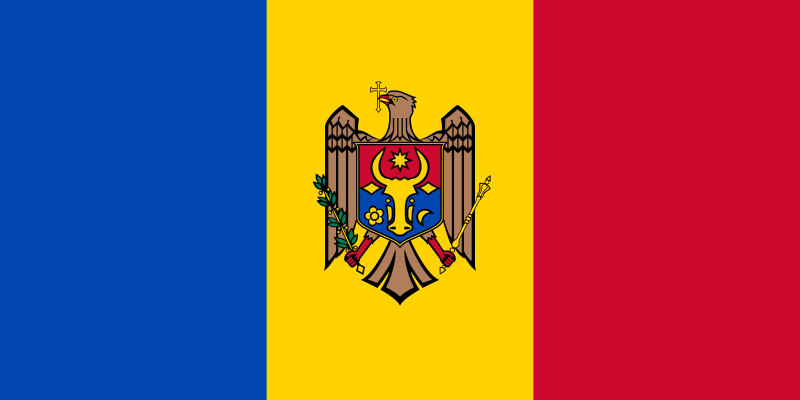
Moldovan Flag
One only needs to glance at the flags to realise that Transnistria is orienting itself mother Russia while Moldova is setting about orienting itself internally creating an identity for itself. This division is carried through to the language - in Transnistria Russian is spoken while Moldova has it's own language.
Gauging the political temperature in Transnistria is the difficult part. There is scant literature about this breakaway territory leaving one to rely on filmed documentaries. Two that I came across paint the place in completely different shades and it sheds far more light on the techniques of documentary film making than it does about subject of Transnistria. The real question to be addressed is that how does one judge the danger in a travel destination based on two conflicting pieces of information? It's something that occurs quite often and is worth investigation.
The first is from the BBC Series Places that Don't Exist (which also includes in other episodes visits to Nagorno-Karabakh, Abkhazia and South Ossetia). Think English public schoolboy toff in a starched white shirt amiably interacting with the natives in a postcolonial age. Simon Reeves is the host, remains upbeat despite some occasionally unpleasant scenes - one in particular involving an elderly woman getting dragged off by police in Moldova for singing a Russian song. The documentary is unapologetic about the state of Transnistria - he relays that his hotel room is probably bugged by the MGB - the Transnistrian variant of the old KGB. In one scene Reeves visits a steel mill, the largest in the former Soviet Union, which claims not to be exporting arms to other countries. Reeves admits that it is entire possible for a steel mill of this size to be doing so and remain undetected while a film crew is allowed in.
Officially the beef that Moldova has with Transnistria is with border control - the border between Transnistria and Ukraine is extremely porous undermining the integrity of Moldova. Reeves does not shy away from this, going to the border which is little more than a dirt road thereby demonstrating that smuggling arms or other illegal goods in such a situation would be extremely easy.
Another issue in Transnistria is the immense power and influence that criminal gangs, indeed one criminal gang in particular, wield. This gang is called "Sheriff" and they have been able to build a massive football stadium at the cost of 200 million euros, while Moldova's one is "crumbling". The ground floor of the stadium is a Mercedes showroom where the latest Benzs are extravagantly displayed. One cannot help but remember an earlier scene in Moldova when Reeves goes to a Moldovan village where a man sold his kidney to buy a washing machine and renovate his house. The implication is that such a disparity can only be achieved here through criminal smuggling given that Transnistria is not able to legally export anything as it is an unrecognised state.
And yet, there are scenes which clearly show that there is no comprehensive system of repression in Transnistria. The first is that they are able to come right up and interview the president during a military parade. When interviewed, the president does not vomit out angry rhetoric, instead he stresses independence, learning from the rest of the world and pluralism.
In the ultimate scene they try to film a "secret" army base, they get quite close to it but they are caught and arrested. They are then released and given their film back.
Now consider the second film about Transnistria - Europe's Black Hole. This opens with a military parade, this is a scene similar to the one in Places that Don't Exist but different by being far more aggressive in nature. Instead of soldiers in dress uniform - they are in camouflage gear, faces painted black and lying prone. These are clearly soldier ready for battle more than just marching around the parade ground. When I heard the opening line "under the eye of Lenin, terror has free reign" my feelers were instantly poised, waiting for sensationalism.
This film relies on the motif of a covert journalist. Scenes are shakily shot in low fidelity film. There are many scenes in a car when the shot drops below the dashboard apparently to avoid detection. The soundtrack is also ominous, drawn out growling bass set to a beat on a kettle drum.
Issues of how reliable this is as a comprehensive picture of life in Transnistria extends to journalistic method as well. Consider the fact that the film's entry point into Transnistria is an arrest warrant issued by Interpol for a person that is hiding there. The association of criminals to the state and the reiteration of the phrase "criminal state" is quite effective until you ask the question - what does "criminal state" actually mean? Not much. Looking at almost anywhere through the aperture of the criminal element and you will get a skewed picture of that place. But this is not just a problem of taking the wrong entry point - there seems to be a concerted effort to skew the perspective toward making it seem more dangerous than it actually is and most of all providing the appearance that the criminal element is one and the same thing as the government. This is given weight by testimonies given by members of the Moldovan government - a government that is still at war with the Transnistria - clearly getting the facts from the enemy.
The implied thesis that the film puts forward is that the Transnistrian people exist under an extremely oppressive regime that is run by criminal gangs. We get glimpses at why they mistakenly associate their lack of tact to obtaining access with repression. When they attempt to enter the same football stadium that was shot in the last film, this time shot from the floor of the car they are in - they are denied entry. The exact dialogue goes like this: "Good afternoon this is a camera crew they would like to look around?" they ask. The response is "that is forbidden". There is no mention of who they work for or what film they are making. Why would someone let you enter and just start filming potentially putting their job in jeopardy? In Places that Don't Exist they did not have any trouble getting access to the same stadium and are given a tour by a very suspicious man in a sleeveless shirt.
This is not say that the film is useless in terms of reliability - one interview describes the horrific experiences of a sex slave that has managed to escape captivity. Attempting to do the same thing beforehand and being punished in a particularly appalling way is the most effecting part.
So which version of Transnistria do you believe? There are certain facts established by the first film that stick in your throat when you try to swallow the second. First - if, in the first film, they were caught trying to film a military base but released with their equipment and footage after a short amount of time, then clearly the Transnistria is not exercising the paranoia that would be expected for the state that is described in the second film. Secondly, how are they able to approach and interview the president which seems free from the presence of body guards which would also be present in such a state? But more than that there is the feeling of freedom of movement - that scenes can be shot at the border relatively freely, that the bank notes printed in Transnistria do not have the president on them because "We don't have a cult of personality of the president" all convey the impression of a state that does have massive criminal problems but is regardless much freer than the one described in the film Europe's Black Hole.
It is important that when people consider travelling to a place that is considered dangerous they realise there are many reasons why somewhere would be labelled in such a manner - the chief one is usually ignorance. I remember travelling to Mexico how paranoid most US citizens were - preferring to cram themselves into US trailer parks instead of crossing the border. This was the results of media that picks and chooses the facts it presents conveying a skewed picture. Also present is self-interest - especially when dealing with government agencies that would prefer their citizens to stay at home - spending their money domestically instead of overseas. I don't know about you but I spent my stimulus money on a holiday OS.
The most tense border crossing I've ever made was with Giulia -
returning from Mexico to the US through Nuevo Laredo in March last year.
Although the leadup was uneventful, the tension increased steadily the nearer
we got to the border, finally reaching fever pitch as our 1976 Chevrolet
Sportsvan was inspected by the US customs station. Aside from the usual fear of
authority drilled into anyone who went to a Christian Brothers school, at the
core of the anxiety was the question what the hell happens once you have left
Mexico but then get denied access to the US? We were essentially in
no-man's-land having already given up our vehicle permit and visas before
crossing the bridge that towers over the dribbling Rio Grande. My assumption
was that the only available option would be to reapply for both, perhaps
dealing the deathblow to our already wretched finances and somehow head back
the way we came. I was curious but I didn't want to ask the custom's guard,
bloated not just with tex-mex cuisine but his own sense of self-importance
questions which would most likely be responded to by "why do you want to
know what happens if you don't get let in?"
I got a jolt of cold lightning up my spine when they asked me for a
document that I did not have. This was followed by soft relief when I was told
that I could buy another one. While I filled out the necessary forms the latex
gloved customs guards went through our van. I spied out of the corner of my eye
a sign which had "You MUST declare" then a list of things which included
mangoes. We had mangoes in the back which I hurriedly declared to one guard. He
came right up to me and said "You're lucky you did that - we could have
sent you back". Eventually, without smile or character, they told us we
could go having left our van a violated mess (unlike the Mexican guards that
always left everything immaculately). I drove off into the Texas afternoon
completely relieved. Incidentally, my plan, if I got turned back from the US
was drive 1100km back to Mexico City - sell the van and fly back to Australia
from there. I would have missed out on my existing flight and a meeting with
someone that had already agreed to buy the van.
Border crossing are almost always tense but you can usually consider
them in isolation, on a case-by-case basis. By contrast the South Caucasus is a
complex web of ethnic tensions, closed borders and Soviet style bureaucracy. This
means that a comprehensive tour of the region must be planned in advance and
take into account each restriction which could impair your movement,
understanding that entry here might cause problems there. It is also important
to take into consideration the mode of transport you intend to take – some states
will place further restrictions or import taxes on you if you want to bring
your own car or motorcycle.
Understand that this region is still in a state of flux - with the
most recent major changes to the map happening as recently as August 2008 with
the borders of South Ossetia and Abkhazia being redrawn as a consequence of
Georgian-Ossetian conflict. The main reason why the South Caucasus has not
organically reached a level of stability is that the freeze imposed on the
region when it was part of the USSR, has now gone. The tensions that predated the
Bolshevik revolution have reignited and begun to smoulder again, occasionally
combusting. As a result it is always necessary to seek the latest information
before you travel there – any one of the countries or autonomous states described
below has the potential to change at any time for a reason as seemingly insignificant
as if one country is hosting the Eurovision finals.
FENCE 1 – Azerbaijani-Armenian border is closed
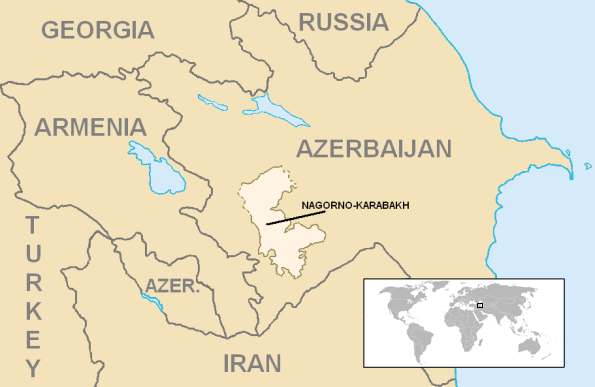
Nagorno-Karabakh - the name alone is a cultural hodgepodge (Nagorno
is Russian for "highland" while Karabakh is Persian for "black
garden). The image (right) of flaming hole in the heart of Azerbaijan has been
taken from the Azeri Ministry of Foreign Affairs website. This flaming hole
(the flames are animated on the website) represents Nagorno-Karabakh which is
an enclave, with an ethnic Armenian majority, entirely surrounded by
Azerbaijan. Conflict in Nagorno-Karabakh has its roots in 1921 when, after centuries
of Armenians and Azeri's living side by side, the early Bolsheviks established it
as an autonomous Armenian state within Azeri territory. This was a move by the
Bolsheviks who attempted to maintain control by exploiting regional tensions.
It is said that Nagorno-Karabakh caused the end of the USSR - being the first
to reclaim power to its local Soviet from the Supreme Soviet in Moscow, it was
the thread that unravelled the whole red sweater breaking a Soviet taboo
thereby undermining the legitimacy of the entire regime. Without Soviet control
Azerbaijan attempted to claim Nagorno-Karabakh as its own. Armenia responded
with the idea of protecting the Armenian ethnic majority there. This resulted
in a series of escalating conflicts began and lasted from 1988-1994 with heavy
civilian casualties on each side. A ceasefire declared in 1994 was by no means
an end to the violence with sporadic skirmishes still erupting on both sides,
the latest of which was in March 8 2011.
Domestic opinion in Azerbaijan and Armenia of the Nagorno-Karabakh
issue is uncompromising toward the other - both see this as a sacred issue over
which they are not willing to budge. The animated image on Foreign Affairs
website perfectly describes how sensitive the Nagorno Karabakh issue is in
Azerbaijan. Although Nagorno Karabakh is autonomous it seems to move in step with
Armenia with the Karabakh party holding a great deal of sway in the capital. The
situation has not improved because there is no dialogue between the two states which
is a function of the less than pluralistic regimes in these countries (in 2000
peace plans were conducted by the respective leaders without opening up the
issue for debate within their societies). Thus if we view the closed borders as
closed not just physically but also in terms of flow of opinion between the
Azerbaijan and Armenia we get an understanding why so little of the explosive
potential of the issue has dissipated since 1994.
The Nagorno-Karabakh issue impacts on travellers in two ways: the
first and most obvious is that the border between Azerbaijan and Armenia is
closed. The second is only relevant if you wish to travel to Nagorno-Karabakh
itself. At the time of writing the Australian Department of Foreign Affairs
site Smart Traveller has the region under a “Do not travel” status. I have
heard that the enclave is most likely safe provided you stay away from the
Azerbaijan border but do not take this as gospel. Nagorno-Karabakh is
accessible from Armenia via the Lachin corridor, a mountain pass legally in
Azeri territory but effectively under Armenian control. A visa is available in
Yerevan the Armenian capital. Note that any evidence of this in your passport
means you would be refused entry into Azerbaijan. I've heard that even having
an Armenian sounding name can cause problems when crossing into Azerbaijan. Ask
for the visa to Nagorno-Karabakh on a separate piece of paper which can be
discarded before entering Azerbaijan.
Also relevant to this border being closed is Nakhchivan the Azerbaijani landlocked autonomous enclave which shares a border with Armenia on the western side. Nakhchivan is geographically isolated from the rest of Azerbaijan, and the Caucasus because it's only borders are with Armenia which is closed, Turkey and Iran. This means that the state can only be accessed via either Turkey and Iran.
FENCE 2 – The Georgian-Russian borders are Closed
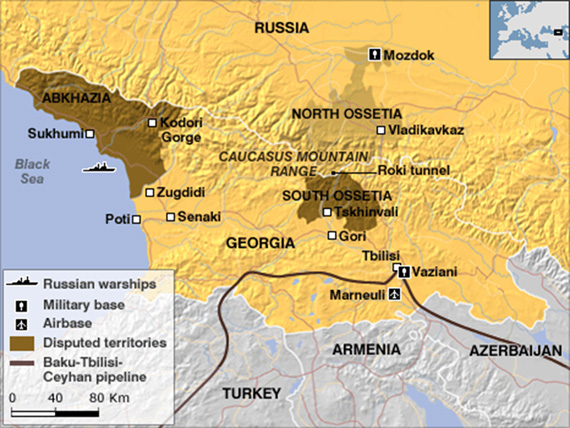
The two states, grouped into a single conflict could not really be more different from one another. First is South Ossetia a mountainous grassland which pokes below the Caucasus mountain range. It's population is poor, mostly Ossetians with a minority of Georgians. South Ossetia separation from Georgia is a legacy from the Soviet Union, when the Ossetians sided with the invading Russian Bolsheviks against the Georgian Mensheviks. The second state is Abkhazia which contains the subtropical sea resorts favoured by Soviet Party leaders, including Stalin, and the Ottoman Turks before them. Because of this appeal Abkhazia has a history of being a cosmopolitan destination home to Greeks, Jews and Armenians as well as it's native Abkhaz population which is slowly regaining a majority after being deported en masse during the Soviet era as enemies of the Soviet Union.
Observe the way that both these states dip below the natural border of the Caucasus mountain range, the highest mountain range in Europe. It is clear that they are implied targets in the "restoration of Geogria's territorial integrity" which Georgia's president, Mikheil Saakashvili, promised to fulfil in his first term. Russia saw Georgia's new Western orientation as a threat, to which it responded by offering protection to South Ossetia and Abkhazia against Georgia. The resulting South-Ossetian war was depicted in the West as the result of Russian aggression but Georgian nationalism and the belief in Georgia that the west would lend more support than it did lead to the impasse.
One of the most bizzare moments that demonstrates how divisive an issue South Ossetia is is in the lead up to war, Saakashvili invited 70s band Boney M (Ra Ra Rasputin) to the Georgian inhabited town in the heart of South Ossetia. There were claims by Boney M that the band that played there that day were actually imposters.
Georgia lost badly in the 2008 war, losing territory as well as having most ethnic Georgian's expelled from Abkhazia and South Ossetia. The borders from Georgia to Russia as well as these two states are now closed, so they are only accessible from Russia. These borders are patrolled by Russian peacekeepers - one of which said in one interview they were waiting to tear off their peacekeeping armbands and go back to war. Furthermore both Abkhazia and South Ossetia, just as with Nagorno-Karabakh, are not recognised as real states by the rest of the world so are forced to rely increasingly on Russia.
In terms of travel plans, without a very large detour through a third country (Azerbaijan-Russian border is closed to most passports) it is a matter of either visiting these two states and Russia or visiting the rest of the Caucasus. Even travelling by boat to/from Abkhazia is not an option as Georgia has a naval blockade of Abkhazia. The best option is if you are travelling into the Caucasus, black out the areas on your map and, travel wise, just pretend they don't exist.
FENCE 3 – The Armenian-Turkish border is closed
With Armenia on the fringes of Christian world it was always going to be exposed when the radically pro-Turkic Young Turks came to power in 1908. Sandwiched between the Ottoman Empire and the Russia Empire, Amenia allied itself with Russia when Turkey lauched an attack on the Caucasus. Turkey suffered one of the largest defeats in military history and responded with the forced deportation of nearly a million Armenians from Anatolia in Turkey. Most died en route to deserts in Syria or Iraq. This is known as the Armenian Genocide.
The current rift between Armenia and Turkey is not due to the event itself but is largely because of Turkey's failure to recognize it as an act of genocide, terming it instead as a consequence of war. A good deal of the evidence points to event as a deliberate attempt to clear East Anatolia of it's Armenian inhabitants. Although there is still a strain of ultranationlism in Turkey that continues to deny the act was genocide this fence is the most likely to come down soon with the Armenian president attending a football game between Turkey and Armenia, congratulating the Turkish president when Turkey scored.
This border being closed does not have a massive impact on a trip through the Caucasus on it's own but when combined with the fact that Armenia also has closed borders with Azerbaijan and Iran requiring a visa to enter, it does potentially make Armenia a little bit of a cul-de-sac. Travel to Turkey is easily achieved using Georgia as a transit country.
FENCE 4 - Limit of 72 hours on a Motorbike in Azerbaijan
While more of a conceptual barrier that a geopolitical fence - this little Azerbaijani policy has the potential throw your entire trip in to disarray. I have had trouble finding where the policy is directly referred to in official government documents but it has been mentioned on numerous forums by people that have experienced it first hand. As far as I can surmise the policy is that it is possible to bring in a car or motorbike for a maximum of 72 hours (to the minute) on a temporary importation document. The consequences of overstaying this is a massive fine for each day spent in excess of this time.
This issue has caused more agony than any others during planning, and might make you try to resort to taking public transport. Considering that at its narrowest point from Georgia to Baku the distance is 333km this might not be a massive problem until you consider exactly where Azerbaijan is situated - which is on the edge of the Caspian, with its border to Russia closed to all but CIS passport holders. As mentioned previously the border with Armenia is closed and besides when travelling to Baku and back you would have to cross the country twice.
The first solution is to leave your vehicle at the custom's office in Baku - this gives you another 5 days to travel through Azerbaijan on public transport. From there you will have to catch a ferry to Turkmenistan which is where the problems begin to arise. Turkmenistan is described as the grittiest of the 'stans and taking a vehicle there a bureaucratic nightmare. Although petrol is 2 cents a liter you must have a guide with you (at $130/day), unless you're on a transit visa, at all times when travelling outside the capital Ashgabat. The logical answer to this might appear to be to get a transit visa - the issue here is that Turkmenistan seems to close its borders with neighbouring countries on a whim - leaving you high and dry with no time left on your five day transit visa to traverse it's desert interior to a viable crossing.
The second solution is to travel through Azerbaijan to Iran. As previously mentioned getting an Iranian visa can be difficult, especially if you're a journalist or from the USA, and perhaps at the time of writing from the UK. A letter of invitation could help and I've been informed that there is a 75% chance of getting in on a Commonwealth visa - but this was before the UK expelled all Iranian diplomats from the Iranian embassy in London. Another issue is that you will not be informed if your application has been rejected, only if it has been approved, so you could be waiting for a call that will never come. It does make the Iranian visa a little bit of a tent pole for the entire South-East Caucasian expedition if you intend to travel by car or motorcycle.
Conclusion
There are only a few possible sequences if you want to visit all the nations in the Southern Caucasus. Hinging on getting an Iranian visa I plan on travelling in the sequence of Georgia -> Azerbaijan -> Iran -> Armenia -> Nagorno-Karabakh -> Georgia -> Turkey.
Today I finally made my way to the RTA to exchange the small pink Motorcycle Riding Certificate of Competence for P plates. Now I can get an international drivers license, motorcycle insurance and consequently I can now ride a motorcycle legally, anywhere in the world. In other words - a crucial tool for the set.
It being the first day the RTA was open since before Christmas, the place was filled with the usual array of the glazed faces of people waiting. I took my number which was low but for the disconcerting letter that prefixed the first digit on the receipt and sat down. While waiting I had time to think. I thought about how Sydney is by far the most aggressive in any city I've travelled to - even any city in the US where despite its assembly of over-macho, immense trucks is a yoga retreat by contrast. I have witnessed friends who are normally relaxed intelligent and enlightened individuals transform into yelling, madly gesticulating banshees their teeth gnashing with impotent rage as they slam the heel of their hand on the center of the steering wheel, their world reduced to a pedestrian that is taking too long to cross. There is the constant manta of "let's teach 'im a lesson" as mad eyes pop in the review mirror scan for a face through the grey fog of the cabin in the car behind, as one such friend will slow to a crawl in response to this car getting too close.
Most of Sydney is drawing on, and emptying themselves into a vast reservoir of collective rage that exists just below the surface its streets. If you remember the 1989 film, Ghostbusters II where a river of slime in the sewers New York city provided a focal point for the population's mutual misanthropy. I envisage something similar.
Now, if you will indulge me in another metaphor, consider the concept of anger as heat. Heat is basically the speed with which molecules move in a substance. The hotter something is the faster the molecules move and, more tellingly, the more pressure these molecules are under the less heat (rage) is required to get a liquid to boiling point (an analogy for losing one's shit). A city such as Sydney has a finite amount of volume where more and more people (molecules) are entering the system - this means more pressure. You don't need to be a professor to understand that the more folks crammed into a small space results in more rage but the analogy is illuminating.
There is of course another factor that cannot be explained by mere thermodynamics. This factor became painfully obvious while I was earning that pink piece of paper I was holding, at the riding centre in Botany. The course consisted of an entire eight hour day, hosted by Upright, a company that is entirely separate from the drones at the RTA. It was entertaining and it was an education. The course was separated into two stages - the first was low speed manoeuvring around witch's hats - where our teacher could observe our skills in a more-or-less controlled environment and correct any bad habits that we had developed. The second stage was a street ride where we were taught how best to avoid getting into trouble on the road. The aforementioned road-rage was referred to, both implicitly and explicitly by our teacher, one example was people deliberately opening their doors to hit a lane-splitting motorbike - a disproportionately large punishment for a minor infraction. Defensive driving was the order of the day and as we all travelled on the road ride, we were given numerous tips on how to respond to idiots driving too close, beeping etc. The response was always "slow down and relax, you'll only get there a few seconds later plus you'll be fine". Numerous stops were employed to demonstrate this fact, whereby the spread of the group was timewise no more than a few seconds from first to last rider. The most interesting aspect was that it bordered on a lesson in Zen philosophy by which our swords of imaginary vengeance were to be sheathed, and aggressive drivers were avoided instead of confronted with "let's teach 'im a lesson".
The contrast between my motorcycle Ps and my car Ps test cannot be overstated. The latter required fifty hours of driving, input into a log book as well as reading a book on road rules (what signs mean etc). The supervisor for this learner could be anyone with a license - so the sins of the father could be passed down to the son. I understand today that there is a necessary thirty hours of training to be completed with an authorised supervisor but even here I doubt there is much emphasis on defensive driving. The test itself lasted barely fifteen minutes and tested the most elementary technical capabilities, such as a U-turn. I remember in my particular test I was stuck behind a bicycle going uphill. I was very nervous and remembered from the road rule book it said never cross double lines, the very type which then de-marked the limits of my lane. This meant an excruciating ascent at about 4 km/h until the supervisor said "Aww just go 'round". I am not advocating driving behind a bike for 4 km/h until one reaches an overtaking lane but it does show there are limits to checklist testing of people's ability to drive. Perhaps there might be a single seminar on the benefits of defensive driving or maybe just a demonstration that you don't have to drive like a dick. Now I'm not a lawyer but personally I think there should be a new law called morbidly aggressive driving, severe transgressions of which, especially for those in HSV utes or Holden Barina's will be punished by chemical sterilization to end the lineage of jerk drivers. Might be a good way to start to lower the temperature on Sydney roads.
About six weeks ago I stumbled on a webpage for the Korean Friendship Association, which seemed, on the surface at least, a shadowy front for the North Korean government to try and encourage tourism and investment. Upon navigating to the travel section of the site, I noticed that barely a month before M and I were scheduled to depart on our grand tour, there was a delegation set to visit on the 100th Anniversary of Kim Il-Sung. 9 months before that, when I had sat down and drew the map that appears as the background of this blog, the idea came up to travel to North Korea. After some research I found out the prohibitive cost, usually a few thousand dollars for just a few days. I realised that this would seriously compromise the reach of the remainder of our journey, so we disregarded North Korea as a potential destination. Upon having seen this new trip would coincide with these celebrations, I was forced to re-evaluate this assessment and conclude that this would be a once in a lifetime opportunity and might warrant the necessary curtailment of social activities required to raise the funds to get there.
To bring those unfamiliar with the top tier of North Korean leadership up to speed - Kim Il-Sung, the father of Kim Jong-Il, has been dead for seventeen years but is still the president of the Democratic People's Republic of Korea (the exact name of the position is written in the North Korean constitution as the "Eternal President of the Republic"). The NK propaganda machine never seemed to work out a way to deal with his death, so the celebration of his 100th anniversary would be, in a country that has become as synonymous with mass totalitarian spectacles as they are with spoilt-brat diplomatic manoeuvres, something worth seeing.
The first phase specified on the KFA website was a preregistration (with an entirely separate process for US citizens) which required no deposit of the eventual 3000 euros. So M and I went right ahead and preregistered. We never expected to hear anything back - the website explains that there is a limit of 30 people per trip, which we assumed would be the total foreign intake for the entire tour, with no rival tours allowed. We were both shocked when we had emails the next morning from korea@korea-dpr.com telling us that we had been accepted and to continue to the next round we were required to deposit 450 euros into a paypal account in Spain. Now, further investigation was required.
I read the itinerary, properly this time, and found there, in writing, that if our visa was rejected or in the case of a "major problem" our deposit would be returned. But certain other facts came to the fore - M's acceptance number was lower than mine, despite the fact that I had sent mine before his. This told me that it was not an automated system on the other side. Scams performed through paypal are unusual because the electronic paper trail which links directly to a bank account which is far easier to trace than simple credit card fraud. Analysis of repeated email communications with this address revealed that whoever was on the other end had, as well as a fairly consistent informal style, a command of the English language superior to one just gained just from formal lessons. In other words - this appeared to be a relatively low risk deposit, which seemed to have a small operation, perhaps one man, at the other end who was probably not a North Korean native.
I was right on in my analysis but am embarrassed to find most of the following information available on the website itself. I did a bit of research into the KFA and found that it was indeed a one man operation, run by the aristocratically named Spaniard Alejandro Cao de Bénos de Les y Pérez, who had fostered an entirely unique relationship for a westerner with the North Korean authorities. He had a North Korean passport as well as receiving several awards and medals, one directly from Kim Jong-Il. Alejandro, according to his wiki page and a documentary made about him entitled "Friends of Kim", regularly organized trips for foreign delegations. It seemed this guy was legit insofar as the tour itinerary was possible for him to organize.
This only left one question - was it worth the money? My saving regime was already stretched to the limit but then again as much as it costs money to set up a new life, conversely, money seems to appear when you disassemble an old one (security deposits, holiday pay, etc) so I would come into enough money before leaving that would make it possible. As another major con it would also mean another month away from my Giulia and I felt that I was already putting a great deal of pressure on our relationship being away for seven months. On the other hand there was potential here for this to be a remarkable piece of travel reportage - one I could use to add heft to my slender writing portfolio. I considered it a no-brainer that North Korea, a country so isolated without mobile phones or the internet and only one state run television station, would be an incredibly interesting travel destination.
I was very surprised by the reaction I got from people when I told them I was considering travelling there. "Why the hell do you want to go there?" "Oh it would be so depressing!" etc. I was hard pressed to explain myself outside "Don't you reckon it would be really interesting?" and I thought that it might come off as a tad perverse to lay down excessive amounts of cash to witness the abject misery of an entire nation as a backdrop of a grotesque theatrical display. Yet there is a strain that runs through certain people, mostly men, of my generation, which is fascinated with these sorts of dismal regimes. It might be worth a brief explanation because I think, that people who do not understand it would be tempted to attribute it to simple morbid curiosity. There is more at work here as well than just a sense of adventure although this is definitely an element which furnishes mere interest with the addition of a sharp thrill. People living in economic conditions so far at odds with our own is also not a sufficient reason for interest (otherwise it would definitely just be morbid curiosity). A culture which warps and shifts to conform to a particular agenda, one which is malleable to the degree which reality is omitted as a collective blindspot is getting a little closer to the mark. Yet when we consider the role that advertising plays in our world - it is evident that our willingness to accept, without regular outrage, as a consequence of living in a modern western context, a constant stream of half-truths and ideals masquerading as facts, we are little different in this respect than the North Koreans. What is particularly fascinating about North Korea is the complete lack of dissenting voices and the unified nature of this warped reality. Instead of our world which is homogeneous because of it's unrelenting chaotic noise - where advertising claims of scientific solutions to the five signs of ageing are met with an eye-rolls - the lies of North Korea must, at least, appear to be believed. This is a completely alien concept to members of my generation and carries with it a myriad of questions - how much do the general public actually believe what they are told? Can an official line dictate reality in spite of what people see and feel? In other words - when they are told that North Korea is a flourishing nation producing amounts of food exceeding their requirements - how do they deny the existence of groaning that is, literally, in their gut?
It has already been pretty well documented exactly what happens in a trip like this - by Vice Guide to Travel and the BBC's Holidays in the Axis of Evil - and written reportage to name a few examples. There seems to be very little variety in these predictably stage managed tours - the itinerary is always various national war museums, statues and treasures (always including the captured USS Pueblo) displays of opulence in the form of banquets of inedible foods held in immense nearly empty halls and shops full of goods not available to the natives, and always with the inevitable mass games spectacle as the conclusion. It is impossible however for the party to manage everything completely - and as such cracks would emerge in official story. It is these cracks that would provide the most fascinating insight into what life is actually like in North Korea - for example Ben Anderson describing the silence and darkness that falls over nighttime Pyongyang or Hitchens seeing people trying to scavenge individual grains of food from fields or Shane Smith having a game to table tennis with a tea lady, as probably as her only customer in six months. The lies are so unified and grotesque that they are are easy to distinguish from truths. So any future trips to North Korea would not be interesting as a repeat performance of the same nauseating lie but the accumulation of these cracks could provide the only real picture to the outside of what life is actually like.
I pitched this idea, in the form of a proposal, to a number of Australian publications which needed not to provide any money upfront and just needed to express interest in the subject matter. None did - giving reasons that could mostly be divided between 'We already have people there covering this' and 'this is outside our sphere of influence'. The former is unlikely as journalists have a great deal of trouble getting access while the latter is sad indictment of the Australian journalism which is now seems solely concerned with domestic affairs. If you think I'm being bitter walk into any Australian news agent and count the number of publications written in Australia that have an international perspective - you won't need to take more than one hand out of your pocket. The most mystifying response I received from a major monthly magazine's editor, who despite me mentioning North Korea in the opening sentence of my proposal replied with "Burma is a bit far from our Australian focus alas, but thanks."
Eventually I lost heart and decided that if the story would not be printed, a major pro for this leg of the trip had now disappeared. This tipped the scales firmly in favour of remaining in Sydney for another month instead of signing up on such a tour. Imagine my disbelief when I walked into the lobby of the ABC after our Christmas lunch to see Kim Jong-Il had died. This has once again brought the world's focus, albeit probably momentarily to NK. I am left to wonder what would have happened if I had taken a punt and leapt into the unknown to retrieve a few shard of reality back to Australia if anyone would be interested.
It is no mean feat to write a guidebook that concentrates on a mode of travel instead of a destination. The focus needs to be unflinchingly fixed on how you intend to get around while the background of where you're going remains as indistinct as fog. The Adventure Motorcycling Handbook achieves a thorough description of the mode but moves outside it's brief by trying to dispel the fog with a piecemeal picture of, literally the entire world.
It is separated into three parts which may as well be two separate books they are so completely different in terms of aims, writing and usefulness - Part 1: Practicalities as the first book while the second book would be Part 2: Continental Route Outlines and Part 3: Tales from the Saddle.
Part 1: Covers everything you would expect from a book a like this: the paperwork required, choosing a motorcycle (including a great series of profiles on different bikes), navigation, what to do in medical emergencies, how to fix a flat, how to change a tire, camping and shipping a bike overseas. As well there is also sections on subjects which I had not considered before, surely the most invaluable part of a book like this. These included an extended section of what to look for when buying a tire, which modifications would be necessary and how to do some of them as well as an entire section entitled "Women and Adventure Motorcycling".
There is little room for flowery writing here (the first sentence of the first chapter is simply "Prepare.") and none is expected. They refer to a big trip as like a major civil engineering project and they clearly intend to describe it as such. This is not to say that the writing is humorless (apologies to any civil engineers that will take this incorrectly) rather it is pared back to what is absolutely necessary to get it's point across. This is important when you consider that economy of space in the book could have a direct relationship with the economy of space required in adventure motorcycling and brings the book along. That is, an unnecessary anecdote on the page, could mean another page in the book, which means more weight on the bike if the book is successful enough in it's aim as to be indispensable. Levity takes the form of dry wit. It was in the profile on the Enfield Bullet that I avidly read and found out my instincts were so fine tuned -in the "What Riders Like" section it said "can be fixed anywhere". I couldn't help laughing when when directly after it says "Don't like: Needs to be fixed everywhere, brakes".
Particularly welcome is the underlying attitude that comes through from the writers which is confident and self-assured. This is immensly comforting to most readers that would be reading this while planning a trip, excited but afraid of the unknown. I would venture to say that this fear peaks when other people say "God you're not going to Iran - you must be crazy" or when you read a government travel warning site. There is a sentence in a paragraph headed "Government overseas departments" in a "Getting information" section which says "Take everything they say with a liberal helping of salt and accept the inevitable taint of politics and convenience which colours their advice." This was like a smile and a "she'll be right mate" that served to quieten rising panic and offset the shaking finger I received when I queried government websites about places I intended to go. This is not to say that they employ a devil may care attitude, rather it was a welcome change from the ignorant doom merchants that beseech you to stay within your own realm.
Within the mix is also included a healthy irreverence for authority which is at it's most entertaining, informative and empowering when about how to bribe officials.
"...never smugly hand over your passport with a wink and a twenty folded inside. This is not how the game is played..."
Then a little fun is then had at the expense of the nations where a bribe is sometimes required.
"On a bike you won't have room to carry a disposable stash of last year's mobile phones, Madonna cassettes"
The first part is entertaining, comprehensive and most of all provides comfort and information to the wary adventure motorcyclist trying this thing out for the first time.
It is in the second and third parts that the book falls down. The second part is a list of continental route outlines. It admits that it is "as broad as a V-Max in a mangle" and indeed it is - the whole of Central Asia and the Caucasus is covered in three short paragraphs. What is there is very useful and focusing in individual routes is the only way to break down the world but the change in pace is so sharp that it was as if the reassuring hand left my shoulder and it's owner begin to run madly around the room, yelling in disjointed sentences and shoving maps in my face. In other words the steady practical plod vanished and what had been a comprehensive and reliable source began to look a little piecemeal. The gaps in information had me wondering why they would either not expand this section to be an entire book, or even series of books in themselves, or remove the section entirely.
The third part "Tales from the Saddle" is a series of trip summaries from some people that can write and some that cannot. Beginning the section with Lois Pryce's Lois on the Loose is a mistake. Not enough of her writing is allocated to setting the scene which dramatically detracts from impact of the story and I was often confused as to where she was and what was going on. I did enjoy Andy Bell's It Pours, Man It Pours especially the section in which he had to catch a business class flight in a jacket crusted with dirt and blood after he was injured. I did eventually lose interest in these people's stories not because they were not interesting but because of the summary way with which they treated their trips, anecdotes are touched on far too briefly. I would have much preferred for people to go into their favourite or least favourite days in a bit more depth. As with Part 2 I was left with the feeling that these sections should have been expanded or removed. While this might seem a little harsh - it's particularly relevant when considering economy of space of the book. Numerous sections, such as changing a tire, would be most relevant on the road but why then would I need to carry tales about someone biking around Australia on my already overloaded bike? It's a bit of a contradiction of purpose. In the books defense it does suggest tearing out sections of guide books that you would consider useful - and it is a testament to the nearly unparalleled practicality of the Adventure Motorcycling Handbook that it would recommend its own destruction.
While not perfect the Adventure Motorcycling Handbook is absolutely indispensable for anyone that is considering adventure motorcycling. It's main strengths are it's comprehensiveness - it patches many of the gaps that inevitably arise from simply looking solely at posts on websites - and the comfort that this comprehensiveness and it's tone offers to someone who is trying something like this out for the first time.
The paradox of planning a trip like this is that you need to try and predict the unpredictable - the only alternative to planning is a deep breath, eyes clenched shut, a prayer and leap. If you need a bit more piece of mind then sooner or later there are questions which require you to go through the immensely dull process of working out contingencies within contingencies. To this end we will map the questions "what is the best way to navigate through the Caucasus on a motorbike?" from beginning to a point where we are satisfied one option is far superior to the rest. It will show how an apparently simple question leads to further questions which lead to more questions and so on. In other words you start tugging on a single thread and the roof falls in. Eventually things get very complicated and you're liable to miss something, or forget it laterif you don't write it down somewhere. The method below is a brute force and thoroughly unsexy way of mapping out all your options. The process is basically continuous refinement:
Begin with a question
List possible answers
Work out questions that need to be answered for each possibility, phrase these questions so they can be answered as Yes , No or I don't know. The answers must also be phrased so an answer of "Yes" is an answer that this would make you more inclined to pick the possibility that it is relevant for while "No" would mean you are less inclined to choose it.
Work out the questions you can answer, and do so with a "YES" or a "NO" if you can't find a definitive answer to one - write "UNKNOWN" next to it. By the end each question must have an answer - this is called completing the tree.
In order to complete the tree you can perform tests which are just a way of answering the question you have posed not through research but by your own experience. Sometimes you might need multiple tests to answer a question.
What is the best way to navigate around the Caucasus on a motorbike?
by Road Map
Is it possible to get road maps of all the areas or do we need do we need to get separate ones for each place we enter?
Time to put Google maps through it's paces. Plan a trip like this:
Poti, Samegrelo-Zemo Svaneti, Georgia (where we could land)
Gavar, Gegharkunik, Armenia
nogorno-karabakh
Baku, Azerbaijan
This is actually quite an indepth trip for Google Maps to work out because it must have sufficient information about the geopolitical situation to know that Armenia and Azerbaijan have their borders closed to one another and despite this there is still a way into the Armenian landlocked enclave of Nogorno Karabakh within Azerbaijan - the Lachin Corridor.
I am pleased to announce that it passed with flying colours. I also tried to see what happens if we navigate to the disputed zone, South Ossetia. Despite the fact that the border would be difficult to cross - it is not technically closed - so a successful route by Google Maps is not a false positive.
I guess that because I'm not totally convinced on one way or the other it shows not to use science to create an art. Even so, I know a great deal more about each option that I did before.
UPDATE: Ended up later deciding to use my old GPS even though it was not water resistent - have downloaded the maps to check them out. I will also buy a new phone and use both these in concert.
On Thursday I had a plan to ride my motorbike to my sister's birthday dinner in Epping. It had been raining earlier but eventually it cleared with a strong wind that dried everything and made the air crackle. I rolled my bike outside the back gate, into the alley behind my house. No sooner had I switched it on when a torrent of petrol began spurting out of the bike all over the road. A man who seemed to come out of nowhere stopped his bicycle and said "Yeah I could smell it from down the street". Then as if I'd called him to come and work on the bike, he got off and began to look inspect it closely. "Ahh you have a bike, right?" I inquired. He told me he was a courier and he lived up the road. He had white hair, yellow teeth and the darkly highlighted features of a long time smoker. When he spied my learner plates, he said "The cops are much more lenient on you if you've got those - keep em for as long as you can".
We traced the dampness upward to a busted fuel line "only two bucks to fix". I thanked him and as he rode off I asked him why he was riding a bicycle "...because I lost my license!" he yelled back.
My lot, therefore, was public transport from here on in. Luckily I had an audio version of Arguably by Christopher Hitchens, a brilliant series of essays and feature articles that he had written for various meaty magazines, mostly from the last half decade. I had reached the "Offshore accounts" section - which contains his accounts of travelling to many places that I had considered for this trip - North Korea and Iran for example.
Iran had been on my mind and in the news all week after headlines about how crowds ransacked offices of the English embassy in Tehran. The English then responded by expelling all Iranian diplomats. M having both a UK and an Australian passport (both members of the same Commonwealth) the chance of getting a visas for Iran seemed increasingly remote. It's such a shame because everything I have heard about Northern Iran says that it is aesthetically beautiful, the locals are hospitable in the extreme - Muslim hospitality is almost a cliche. My interest had peaked when I had been walking home before the fuel line incident and was listening to Hitchen's describing the bridge in city of Esfahan (the city itself is described as "a miracle of proportion") in his essay "Iran’s Waiting Game" as:
Many fine bridges span its river, one with 33 arches in which slits have been carved through three walls. When you stand back and view them from the right angle, they give the perfect outline of a candle, while allowing you to see through to the other side. This miracle of perspective—such ingenuity for such a slight but pleasing effect—is seconded, if you like, by the tower which will convey the merest whisper from one stone corner to another.
The combination of this deep interest and the knowledge that my chances of seeing Esfahan were dwindling, poised on events far outside my control, brought about a longing in me. But I remembered that when travelling one had to be versatile and I began to search for a contingency plan. Luckily enough my expulsion from the motorcycling world for that afternoon meant that sitting by the window and looking out into the sepia afternoon sun, at the rust coloured warehouses of the train depot, like slumped empty overcoats I had the time to get to an essay about nine later in the collection which discussed Hitchen's trip in Kurdistan, Iraq. The Kurdistan have made an attempt to differentiate themselves from the rest of Iraq with a tourist campaign, the Other Iraq, which seeks to bring the western tourist dollar to their autonomous region. He spoke of it as a safe place, free of the sectarian violence that plagued, and still plagues, the rest of the country.
Iraqi Kurdistan is in the North of Iraq and has been autonomous since 1970. It is home of the ethnic Kurds who were repressed under Saddam (he tried out chemical weapons on them) - then betrayed by the West, when the US invaded the first time one of the pretexts was to save the Kurds - but they pulled out before the job was done. Despite this they seemed eager to show their independence from the rest of Iraq, both with regards to character and autonomy, and encourage Western investment. They have even built their own version of McDonalds, MaDonal. There are parts of the essay which strike a particularly melancholy but inspiring chord. That a people whose homeland overlaps the nexus of Turkey, Iraq, Iran and Syria could ever hope for any form of unity. How they have been constantly repressed while falling from the international worthy-causes spotlight. Despite this they have had the tenacity and courage to rise up, make a grasp global involvement and relevance. Sounds like somewhere that I might want to visit.