Sunday, March 18, 2012

St John's First Aid Class

It didn't begin well, M, having left his booking until the 11th hour, rang the head office to ask if there were any places left in Sydney. There weren't. At least in the location I had been given. In fact there was no class at all in the location I had been given, the building recently vacated, St John's premises moved from George Street to Clarence Street. Still the $190 had gone out of my account so I was in the class whether I attended or not.

On the morning of Saturday 17 March, rain hammered down, preventing any potential for motorbikes to be used as transport. Instead we climbed into a cab, the amiable, uniformed drive had his wet civilian clothes crammed into a plastic bag in the boot. We got there and went upstairs into a newly painted office - walked into the correct room which had half a dozen people inhabiting the bunch of chairs. Our instructor Malcolm, was no nonsense. He had been a school teacher for many years before specialising in becoming a St Johns instructor and it showed. The proceedings were in the teacher-student format - the long rambling anecdotes by some of the class were thinly tolerated but rarely expanded upon. A sweet mercy. 

The content was far enough away from a Personal Development Health class so that I could have respect for it (a hangover prejudice I had from school where the the health teachers were PE teachers with books and I always had a deep loathing for PE). Right off the bat they gave us what we wanted and we spent the morning learning the recovery position and CPR. The recovery position, done in pairs, was simple - check the scene is safe, call for help, check for breathing, move the patient on their side, clear the airway. If the patient was not breathing then we would have to perform CPR. This was done using manikins with a docile, sleepy expression on their inert faces. "30 compressions on the chest - to a depth of one third of the cavity. Do this is real life and ribs are going to break". The armless, legless manikins did not seem to mind until Malcolm took off a panel on the front of their faces to reveal a shocked empty eyes and a vacant space behind the nose. Terrifying. Our CPR skills were all evaluated, then next we were shown a promotional video for a defibrillator. 

Meet Joe Ordinary - he lives and works in London. The video begins with his voice over the top convincing us just how average his life is. Only its not, his job consists of having to deliver reports at ever earlier deadlines. As if this wasn't enough - there seems to be a chronic stationery shortage in this office and he seems to be the guy that everyone asks where this missing stationery is. All this is delivered in an accelerated series of flashes which conveys mounting tension. The only way out? Heart attack. CPR doesn't work (it only works in the event of flat-lining not erratic heart flutters). "It was curtains for me after that" Poor Joe. An alternate ending is shown, this time with a defibrillator close at hand. Joe lives to stock the stationery cupboard and deal with soul crushing deadlines for another day at least. 

The defibrillator is quite an amazing piece of hardware - pads are placed on either side of the heart - one near the right shoulder, the other a handspan below the left armpit. Once opened the defibrillator will take you through the procedure, tell you where to place the pads, monitor the heart rate and deliver appropriate shocks. With a theatrical flurry Malcolm shook the dummy as the charge went through. 

The second day we went through a series of scenarios, alternating with theory. We learnt how to deal with head, neck, abdominal and spinal injuries, broken bones, stings, poisons heatstroke, hypothermia. The subjects were diverse even if not conveyed in great detail. One interesting factoid was informing us to the existence of a white tailed spider and its sting which eats human flesh (arachnogenic necrosis). The accompanying anecdote was of someone that was unknowingly bitten, the poison lay dormant for a year and then this person began to lose flesh off their bone like a well cooked lamb shank  

The only disquieting thing about this course for our purpose was the continual emphasis on calling 000 - quite a distant prospect on the plains of Azerbaijan. Regardless enough was learnt to put us in better, if not, ideal stead in the case of an emergency. If we had more time I would do the remote first aid course. 

Wednesday, March 7, 2012

Packing Minimalism

November 2004. Marc, James and I stagger through the automatic doors of Heathrow and outside, into the adjoining bus terminal. It's cold, grey and ugly, the clouds sit low above the surrounding buildings forming the roof of the cage. Everyone seems to have bags under their eyes and are smoking like they are midway though a long prison sentence. I can remember thinking two things - firstly, that this is a strange place to escape to. I had lived in the same room for twenty one years, the curtains, installed just before I was born, still had clowns on them. I had assumed that I'd arrive in London to some fanfare not this insipid and pathetic vista. Not even the cold was intense enough to be impressive.

The second thing I thought was how the hell was I going to get this bag to my hotel. Marc and James were in the same situation and as we smoked our duty-free bought cigarettes our massive bags sat in an untidy heap like passed out Australians at Oktoberfest.

I can remember the tube ride from Heathrow to Earls Court. The carriages had seats along each wall, facing the centre of the aisle. They are designed for people, not luggage. We stood there, three boys, each with 100 Litre bags, in everyone's way. Each time the carriage lurched forward or slowed to at a station, the three of us were thrown down the aisle, to be collected at one end or the other, indiscriminately treading on shoe and boot alike. Luckily the people on the tube were more Englanders than Londoners and were to polite to say anything.

Eventually we traversed the six zones and alighted onto the platform. The only way that I could get up the stairway, to street level was to angle myself forward so as to form a counter-weight to my massive bag, hold only the handrail and heave myself up two or three stairs at a time. It was slow going. I can remember a glimmer of something which I now recognise to be the realisation of irony. Here I was - come to be free, tear myself from home turf  and history and weighing me down was this colossus of a bag like some grotesque hump, containing half my history in it.

Luggage invites metaphor - think emotional baggage for example. The actual meaning of these metaphors always hit the same registers - your freedom and movement are restricted by this "baggage" which is entirely superfluous to your needs. Thinking back to what I actually packed for London it was ridiculous. There were suit jackets, rain jackets, multiple pairs of shoes, that, through lack of use, slowly worked their way towards the bottom. By the end I could take a soil sample and tell what I didn't need by what I didn't by its relative position in my pack. As the trip continued and I accumulated various presents and items. I also got as strong as an ox By the end this 100 L albatross was packed to bursting point, weighing 40 kg, with weird protrusions and lumps it looked and felt like 20 cutlery draws had been emptied, then wrapped in a bedsheet.

This time around I am trying something different. I once read somewhere that when travelling to the US bring half the amount of clothes and twice the amount of money. I'd say this holds anywhere except the third world and I want to put it to the test having traded my 100 L Goliath for a more modest 40 L number. Its not enough to just scale down the operation though - it has to be done right. Apply minimalism to packing - reduce to just the necessary elements and derive beauty in function. In keeping with this concept, you bring as little as possible but what you bring has to be versatile, compact and rugged - the premium is on the right stuff not just not much stuff. Consider the bag itself - this time I am going with a hybrid which has both wheels, for pulling on the ground and straps for it to function as a backpack. It weighs just over 2kg and can have a daypack attached to the front.

Once you have the bag there are simple rules for packing:
  1. Forget the formalwear - truth is you're probably not going to get invited to a Raj's weddings and if you do, the stripped back explorer look is going to give you way more cred than a suit that looks like it's been ridden hard and put away wet.
  2. Mention the unmentionables - undies and socks for at least a week. You don't want to be washing the same pair every night and for god's sake spare a thought for them too. Irrespective of the state of your top layers - put on fresh undies and socks and you'll feel like a millionaire.
  3. Digitize - sure it's going to be great to have half the literary canon of western civilization on that long train ride but is it worth having your spine bent into an ampersand? Get a Kindle or better yet audiobooks are awesome and can be listened to with the lights off so you're not going to piss anyone in the dorm off.
  4. Pack for the season - look up the weather conditions of where you are going in advance, the average temperature range and rainfall, and pack for that. Cleave items unsuitable for this range from your packing list. 
  5. Layers - are versatile - thermal underwear can be crammed into a pencil case and when combined with a shirt and a jumper can be just as warm as a big jacket. You don't need a different shirt for the cold as for when it's hot - you need one jumper.
  6. Do a Practice pack - this sounds nerdy but the last thing you want is to be wandering into Sydney airport looking like a bag lady because you got too ambitious on luggage buying day for luggage packing day.
  7. Buy a microfibre travel towel - when I went to London I bought a "bath sheet" from Debenhams which when subjected to geological amounts of pressure could be compressed into the size and density of a bowling ball. Ridiculous. Truth is even most towels will take up more room than their worth and be a sad soggy weight in your sack. 
  8. Tear out relevant sections of Travel guides - your reverence for your books is going to have to play second fiddle to your reverence for your back. Why carry around weight that you're never going to use?
  9. Beauty in function - learn to get off on economy of space. A Swiss army knife or a leather-man is beautiful because it's the product of so much thought, because you can stick them in your pocket and because it sets you free. Unless, of course, you forget to take it out of your carry on luggage.
  10. General rule - when I thought about it, all the extraneous stuff in my luggage was the result of a bunch of "what-if" statements, made at home which never eventuated. Strip this mode of thinking while your working out what to bring. You will be left with what you actually need.

Wednesday, February 29, 2012

The Yearning

I can remember watching an episode of Press Gang as a child. Linda left the cramped offices of the school newspaper, running out in a huff because of something Spike said. I remember the next shot clearly. It was a long one, especially in this usually cloistered show. A suburban street was lined with oak trees on either side. For me the drama of the show was momentarily muted, drowned out by something imperceptibly alien about this vista. I was growing up in the suburbs and seen oak lined avenues many times before but nevertheless, I wanted to go there. I had a yearning to travel to that exact same spot and immerse myself in its differentness and somehow to absorb it.

I had more such pangs as I grew up and I began to notice a pattern emerging with regards to the type of vista that would conjure such a feeling. Firstly the vista could not be so original or its scale so awesome as to inspire awe. In this case it was impossible to form a connection to such a vista because it is just too alien, too far outside my day-to-day experience, to be able to imagine myself occupying the same world as it. A photograph of the Grand Canyon or a massive glacier, for example, would not instil the same flavour of yearning. Far more effective was urban or suburban scenes.


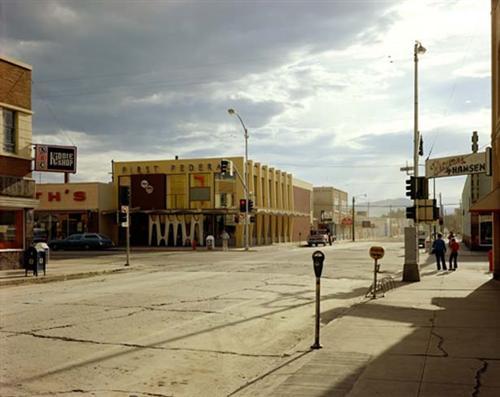
In 2010 I went to an exhibition on on New Topographics at San Francisco Museum of Modern Art. The photo exhibition documented everyday USA. Apart from its historical relevance, the museum was hard-pressed to describe why these photos were interesting, in fact going to fairly great lengths not to use the word "boring". I suspected that people were beginning to take interest in them because they had begun to be historically important. I remember something strange happened when I walked around the room looking at photos - the pangs of yearning went off again and again like a repeating gunshots. Whatever was the common thread between these pictures was most likely the thing that lead to this yearning. I was able to understand this feeling as the result of the following process:
  •  The initial connection is made through recognising the scene as normal, in the sense that these scenes are contexts which the locals that inhabit them consider unremarkable. 
  • Your mind searches through its store, trying to find something in your history to anchor the scene to personal experience but comes up with nothing.
  • You then project yourself into the scene. The yearning arises from the hypothetical -
    "what if my life was that life?"
And that is the linchpin of the entire yearning. It is the moment when the frame of the picture simultaneously forms both a mirror and a window. The familiarity of that framed world allows you to project yourself in there while its foreignness, strips you largely of your history and allows you if not to live someone else's life, then to at least see what they would see. The yearning is the melancholy understanding that you are trapped within your own history and that history has set certain irrevocable parameters so that your course - no matter how wild its deviation from its former trajectories is still bounded and finite. The Yearning is recognition of the limits of your powers. Fundamental to this is the everydayness of the scene depicted because you may visit the place but the associated history that allows the world to become everyday is only possible is only a possible option to you at the exclusion of other places and histories. It is the end of the idea that everything is possible all of the time. The pang is the end of your part of your youth and through this it allows you to become a different person.

What is the relationship between travel and yearning? First it is necessary to draw a distinction between travel and tourism. Travel is a form of self-projection (literally and metaphorically) while tourism is a form of voyeurism, that is - travel you're inside the scene while with tourism you're outside of it. This distinction is so important because an aspect of yearning is empathy with the humanity of your surroundings - to sit outside and to watch it restricts this empathy. Rather, to be 'in it' and to experience its newness is to remove the melancholy note from the chord, thereby transforming yearning into fascination. This world - is now your world, like bubbles coalescing, and with it the parameters that define your path have grown.

Wednesday, February 15, 2012

Tour Chernobyl

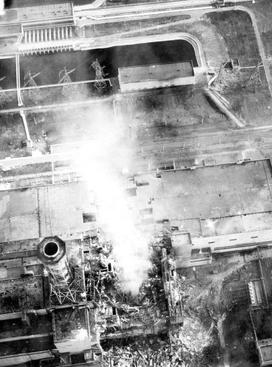
1:23:04am on April 26, 1986 Soviet scientists begin an experiment, shutting down the turbines in Energy Block #4 of the Vladimir Ilyich Lenin Power Station at Chernobyl. 1:23:58am extreme vapour pressure from a build up of steam in the cooling system causes a sudden explosion which tears off the reactor's 2000-ton upper plate. A few seconds later a nuclear excursion, a more powerful explosion accompanied by a huge surge of neutron radiation fires into the early morning sky.

By 1:26am, a fire alarm is raised and fire-fighters, both local and from the nearby town of Prypiat, arrive. The firefighters have on only their canvas uniforms which are completely insufficient to shield them from the radioactive caesium, iodine and strontium isotopes shot into the air from the raging fire. They are the first ones to suffer from radiation poisoning and are in hospital before the official party explanation of a gas explosion is abandoned. As people drink their tea on their front porches and watch the beautiful "kind of shining" fire in the distance unknowingly ingesting the radioactive dust, Soviet authorities deliberate and eventually give the order to evacuate an area of 300,000 hectares – which includes the city of Prypiat, population 30,000.

Chernobyl becomes a global event within just over a week. Gaseous airborne particles are measured in India, the US and Canada. The Soviet response of mass mobilisation of 500,000 reservists provides an approximate equation of manpower and nuclear power but never really indicates the cost in life and the effort and balls involved in the cleanup process.

The unprotected troops that throw out the sacks of lead from helicopters just above the column of radiation which shoots out of the reactors core. Of the 600 that do this – all will eventually die of radiation poisoning. Another example, is the miners, drafted from outside the exclusion zone. Given the task of working in three hour shifts, 24 hours a day they tunnel under the reactor, digging out a room to be used for a refrigeration unit to cool down the white-hot radioactive magma above. Consider this for just a moment, the sweat and the dirt, the heat and the imminent danger from tunnel collapses and trapped underground gasses all native to mining, exacerbated by an operation thrown together and run round the clock. Only now, you’re under a radioactive core and white-hot magma, which has already cut through the concrete supports of a nuclear power station, is now eating its way down toward your head. Failing to stop the magma would result in a cataclysmic explosion once it reached the watertable not far below. Radioactive steam would then shoot up contaminating the air while much of the water supply of Eastern Europe would be undrinkable.

But perhaps the most unsettling are the "Bio-Robots" – troops given the task of removing ultra-radioactive detritus off the roof of the reactor so a massive concrete sarcophagus can be placed on top. To give some idea as to just how radioactive this area was – the original plan was to have full sized remote controlled trucks do the work. These trucks had their interiors lined with lead and even then the radiation was so strong that it played havoc with their electronics causing them to go berserk – one flinging itself off the edge and into the melting reactor – a pretty terrifying prospect if you were then asked to replace it with yourself. The Bio-Robots had to sew their own protective suits in a single night and only then could work for 30 seconds at a time to minimize their exposure. They would do this only once or twice per person. There has been little documentation on the survival rates of these bio-robots but one would think it not good considering accounts the taste of lead never went away.

Eventually the hastily constructed sarcophagus was put into position, sealing off the core and smothering the blasting radioactivity to a mere trickle. Technically, the people of Prypiat were never allowed to return although some of the older members did, highly sceptical that an invisible thing like radiation could harm them, or just too old to care.

In 2010 the Ukrainian government opened up the exclusion zone to tours. They were running before, illegal but unchallenged. Why would anyone want to enter the exclusion zone, to cop a serious helping of radiation? Simple morbid curiosity? Perhaps. But I think the answer is a mix of the past and future.

From the moment the Berlin wall fell, and the door to the Soviet experiment was shut  forever, Soviet life stopped being a reality and became a relic. Any attempts to preserve a bygone way of life always comes off forced and sterile while to recreate one comes off kitsch and contrived. That's because usually there is no 30 km exclusion zone and the historical world has to coexist with our own. What is fascinating about Chernobyl is that the exclusion zone forms a reverential veil as if it's clear that you're invading another world instead of another world invading yours.

The authenticity would be pitch perfect too as the inhabitants by and large were evacuated and never returned. I was once told a story by a man that went there. He kicked open a door of a room in a abondoned hotel and saw a pair of pants folded on the end of the bed. That means that minus looting everything everywhere would be exactly as if it was lived in by Soviet citizens specifically because it was lived in by Soviet citizens.  In other words - you get to walk around in a world that really did exist by no longer does.

You only have to cast your mind back to last year to the Fukushima disaster to know that we're constantly rolling the dice when it comes to nuclear power. Taking this, and a quick nuclear warhead count, into consideration - it doesn't take a doom-sayer to entertain the possibility of mankind turning at least a portion of the earth into a gigameter-clicking wasteland. To anyone that has wondered "What will it be like after we're gone?", the Red Forest is an area inside the exclusion zone which has concentrated radioactivity. It is home to an increasingly diverse range of wildlife, including wild boars and wild dogs. The return to wildness is a particularly chilling note to strike considering domesticity is mankind stamping his own character on the natural world. Despite the legacy of centuries, within the space of a decade this stamp vanishes.

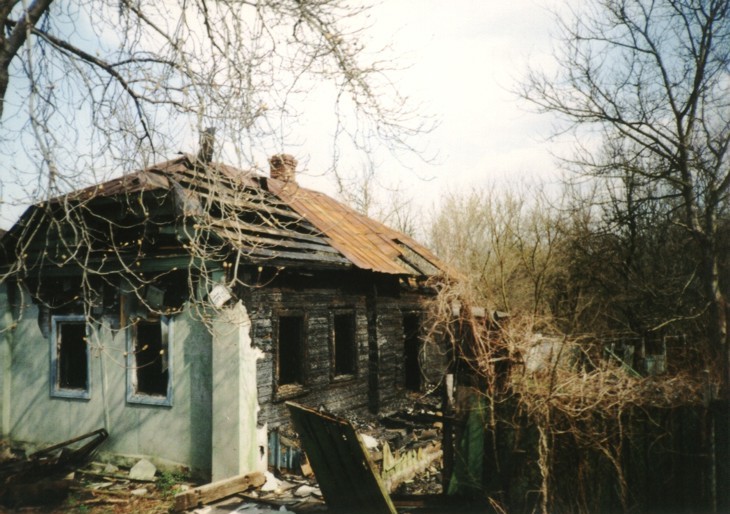
The empty city of Prypiat is fading too, and nature is reclaiming it. As the the billboards fade and the cement cracks, new saplings push through those cracks. Most buildings are now too unstable to enter but the vistas of long, overgrown, Soviet avenues, cars along its fringes would be profound. Within sight, down at least one of them on the horizon is reactor #4. No one is quite sure exactly what is happening under the concrete shell but there is still the hum of radiation, like a search beacon, alone and marooned in the night sea.

Thursday, February 9, 2012

Australian Exports

As Australians we get a pretty good deal whilst travelling - our dollar is high, our airfares are low and our reputation as a fun loving, raucous, give em a fair go species almost always precedes us. It's a reputation that is not, as with, say the Americans, undermined by our foreign policy, which is either meek or eclipsed by other players big enough drown out our voice. For many Australians the virtues of our reputation are well earned. We have fun but conduct ourselves with respect for locals, their culture and history. But for many, and I would venture to say an increasing number, the nature of this reputation has often functioned to disguise boorish disregard for locals, as boisterous love for life. Only now, the wind is beginning to change and, as this disguise becomes more and more threadbare, the rancid smell of vomit is starting to blow back in our faces.

Perhaps some anecdotes to demonstrate what I mean when I say boorish disregard for locals. I can remember a short conversation I had with a fellow Aussie, at the smoky bar at Phuket International Airport. He and his wife were on their way back to Sydney after being holidaying there for two weeks. When I asked him if he had enjoyed his trip he replied in a gravelly voice "'was great - I was at the pub, gettin' smashed, every day while the wife was out buying souvenirs". One might ask if they sold souvenirs of a leathery faced man sitting at an Aussie pub "gettin' smashed".

In London I attended the regular event "The Church" held in a massive warehouse in Clapham Junction one Sunday. This event almost exclusively catered to the antipodean backpacker demographic. Beer was sold in lots to three pint-sized cans, and accompanied with a plastic bag, which once tied around your belt, hold the cans not being drunk. There were a series of acts, including strip shows, which could barely be heard above hubbub. A little risqué but far from loutish. As the day carried on, things descended, and it began to dawn on me that the floor was covered in saw dust to absorb the vomit and piss that was now in free flow, spouting from men and women alike throughout the place.

The difference between those of us that are uncouth louts and the rest that are overseas just trying to have a good time is at its core a difference of purpose and it's high time that many of us asked ourselves why we're going overseas. If you're travelling to enlarge your world with the understanding of another's then you've earned the Aussie reputation. On the other hand, if you're travelling to another country just for cheap booze and the chance to trash someone else's backyard then you haven't. This is because intrinsic to the Aussie reputation are the concepts of egalitarianism and a fair go. If we really believe in these things, then it cannot end at our shores and it must be applied universally.

We have next to no control over our exchange rate, which is, as it stands, gives us a monetary advantage over the vast majority of other countries. Combined with this, our unprecedented access to budget flights mean that it is often cheaper to holiday overseas than domestically. This can lead to a dangerous line of thinking, a form of tunnel vision that discounts everything except for where the money is going. It implies that the mere act of bringing money overseas is worth something in itself and it fosters a customer cashier mentality between them (the locals) and us (the tourists). This McDonaldification of this relationship elevates us above them and subverts our egalitarian tendencies. In other words - we're the customer, we're always right and we're entitled to whatever we want.

The consequences of this line of thinking is that locals are treated as an endless line of service staff, their culture, history and environment commodified when of interest to tourists or ignored when not, as a form of tourist colonialism. This is a manifestation of the unworldliness of mainstream Australian culture. People will cite multiculturalism as a counterpoint but although Australia is pluralistic and culturally diverse, the interest that mainstream Australian has in the outside world is stunningly thin. Just watch the news on any of the commercial stations and take note of how many international stories are run. I think that a curiosity in other country's cultures could go a long way to bring about a respect for the locals when we travel. Before you think that it is idealistic to expect all Australians to put down the budget booze and pick a history book, perhaps its worth considering a reversal of roles, whereby Australia features as a mere tourist destination.

Consider the proposed development of a second $1 billion Casino at the Barangaroo site. In the News Review supplement of March 3, Sydney Morning Herald there is an inset box with a series of quotes which includes one from a Mr John Lee, the Chief Executive Officer of the Tourism and Transport Forum: "It's not our place to cast aspersions on the likes or dislikes of our international guests. We must understand what they like and provide it" In a country that is currently losing a war against problem gambling, in a city with some of the highest housing prices in the world, the development of land that has just been opened up in order to build a second casino seems entirely contrary to local interests. The quote "not our place to cast aspersions" clearly implies that social issues which are attempting to address problem gambling pale into insignificance compared to the tourist dollar. Such "steamrolling the locals to roll out the red carpet for the tourists" mode of thinking does a disservice to us as a tourist destination because it reduces our cultural appeal to that of a ug boot jammed into a poker machine.

If you've ever watched an Australian tourism advertisement, intended for overseas audiences, wheel out the same clichés it has since Crocodile Dundee you'll get an idea about just how glib a business tourism is. These ads does not show the real us but how the world wants us to be. It's our authenticity that's up for sale as we're mostly being pedalled as a ridiculous caricatures. This happens in all tourist campaigns - which if were believed we'd be a world of stereotypes - flinging boomerangs and chopsticks at one another.  My point is that these caricatures, the lifeblood of the tourist industry, are a symptom of a disregard for the local culture, something that us as Australians, need to be constantly vigilant against lapsing into. So when travelling remember where the bloody hell you are.

Friday, February 3, 2012

Disappearing Dragons

Remember when you discovered wikipedia? "What? So people can just write about whatever topic they want  and leaderless hordes of users will self regulate and enforce the accuracy of their own articles somehow creating a massive body of reliable information on every conceivable subject? Good luck with that."

It's strange that Wikipedia seems to stand as an anomaly - a isolated counter-example to almost every other public forum on the internet where discussion seem to all inevitably descend into a discussion on Hitler. Somehow the creators of Wikipedia have put into place a system which appears, at least from the outside, to avoid hierarchy, free from centralised control of the information it creates, while still remaining, for the most part, accurate, relevant and reliable. It is precisely the headless nature of this monster that has sterner governments nervous. But all this is old news.

In the same model as Wikipedia - is a sort of wiki-maps - OpenStreetMap. Launched in 2004 with an explicitly Wikipedia collaborative style of information harvesting, OpenStreetMap began with a completely blank slate, relying on its users to provide all its data. Users do this in numerous ways - but most of the hard data comes from contributors recording their movements with a GPS then submitting the coordinates to the site in order to plot a particular street. OpenStreetMaps have also had numerous offerings of existing sets of data such as satellite photographs and submissions from Yahoo! and even Microsoft which have complemented the user generated data to provide a much more complete picture.

In Berlin's Zoologischer Garten - the detail is down
to the individual animal's pens
In traditional parlance of cartographers the phrase "here be dragons" (as well as placing images of dragons and sea serpents on maps) was used to delineate to uncharted territory, as well as consolation to anyone feeling alone in their fear of the unknown. In this vein, there still seem to be plenty of dragons on the OpenStreetMap which consists mostly of a series of ultra-detailed islands of data in developed countries, while vast tracts of the underdeveloped world remain uncharted. If Wikipedia, as well as the theory of exponential growth of information, has taught us anything is that sooner or later OpenStreetMap's dataset will be increasing at an intimidating rate. There is the potential too for a level of detail that is hitherto unknown in mapping for example contributors in Germany going to the level of mapping individual trees.

If there is anything we've learnt from Wikipedia is that there is a certain cross-section of society which are excruciatingly relentless when it comes to the accuracy of information. In a psychological study of Wikipedians found that they don't fare well in the five traits openness, neuroticism, conscientiousness, extroversion and agreeableness. In other words they are a bunch of spiky personalities that come together to argue about the minutiae of obscure historical subjects when they're not getting bogged down in a neverending string of definitions and counter-definitions. Not my idea of a good time though perhaps necessary to get things right. Yet, if there is any metric by which the quality of a map can be evaluated it is its accuracy. Furthermore, it would seem that there would be far less room for debate when plotting maps than regarding almost any historical subject - ie either there is a train station at so-and-so-a-place or there ain't - it's that simple. Yet if you consider the ways in which contributors can get involved includes correcting errors you can be sure that these spiky personalities are going to find something to argue about.

What OpenStreetMap is able to harness that Wikipedia cannot is that almost everyone is an expert on something relevant to the project, which is to say that almost everyone is a local to somewhere. Locals are going to know much more about their locale than someone else and allowing OpenStreetMap to be a composite picture for all local pictures is something that has not been attempted before.

OpenStreetMap only being concerned with mapping and not the control of information also impacts accuracy. Consider when cartographers used to insert fictitious entries into maps to prove any cases of copying - the A-Z map of Bristol had the non-existent street "Lye Cl." for instance. No such controls will be in OpenStreetMaps with a legion of hair-splitting contributors to correct an errors, intentional or otherwise. Furthermore, as the corollary of a lack of information control is accessibility, each map is open for use to whoever for whatever. The addition of different layers to maps, for example, allows someone to superimpose any Geostatistical information over the top. This includes crime statistics or demographics to be overlaid to see what is happening where. In addition to this there are different maps for different purposes - there are bicycle maps, marine maps already for OpenStreetMaps.

The real power of OpenStreetMap is in its use not its generation. I am in the middle of planning a motorcycle trip around the Caucasus and actually finding a way to navigate around there was extremely difficult. In terms of commercially available road maps the best I could do was a German made fold-out number, in the not-so-great size of 1:650,000 which was already a year old when it was delivered. Sure Google maps is great on your home PC but to get it onto a phone requires pre-caching and awkward third party software if you don't want to be slugged with a huge data usage charge on an Armenian network, plus who knows what local controls they have in place when you're there. Another option is to buy proprietary maps for your GPS - these come out once a year so are not going to be as up-to-date, plus if you are travelling to many different regions it's going to get quite expensive. For all my entire route I was looking at paying at least $500 for the maps alone. Instead I was able to go to http://garmin.openstreetmap.nl/, highlight the map tiles that were relevant to my trip, submit my email address. Moment's later I received an email with links to the map that could be loaded directly onto my GPS. All free. Admittedly I had some issues with the routing but I'm quite sure that was due to the GPSs mapping engine - not OpenStreetMap.

Governments have historically been extremely nervous about maps as they have been with other information. Imagine,as I have, that you were arrested as a spy as you were plotting a road to submit to OpenStreetMaps in some backwater country under a despotic regime. Your first reaction would be that that is a ridiculous concept. But when you consider that you are recording data and uploading it to the irrepressible internet cloud you might see things differently. In other words, maps are a fundamental tool of control provided the information they contain is controlled too. OpenStreetMaps is the first mapping database to be as yet unanswerable to any one person or regime. As the completeness of its data set becomes less and less about the development of uncharted parts of the world and more about how easy it is to get information out of certain places, OpenStreetMap will have unintentionally provided a political map where detail is equated with freedom, and lack of detail with repression, showing exactly where all the dragons be.